TRANSDUCTION TECHNOLOGIES
  • Home
  • Commercial Services
    • 2018 IECC Test
    • Building Enclosure Testing
    • Data Monitoring
    • Energy Evaluations
    • Infrared Thermography
    • NFPA Enclosure Integrity testing
  • Residential Services
    • Passive House
    • New Homes
    • HERS Index
    • Energy Efficient Mortgages
    • Existing Homes
    • Building Owners/Managers
    • Tenants
  • Resource Center
    • 2018 IECC Testing
    • Houses of Worship
    • Schools & Community Centers
    • Shelters
  • Past Projects
  • Building Science
    • Articles
    • Midtown Monitor Columns >
      • Article 1: Seal Tight, Ventilate Right, Part 1 >
        • Supplemental Air Sealing Articles
      • Article 2: Seal Tight, Ventilate Right, Part 2 >
        • Residential Ventilation Calculation Examples
        • Ventilation Advise & Articles
      • Article 3: Should I service my air-conditioner?
      • Article 4: Home Performance Guild of Nebraska
  • Inflation Reduction Act
    • Residential IRA Benefits
    • Can I get a free heat pump
    • IRA Resoucres
  • About Us
    • Overview
    • Capabilities
    • Contact Us
    • Affiliations

What is a Passive House? 

A Passive House is the most stringent building energy standard in the world. Buildings that meet the Passive House Standards use 80% less energy than conventional buildings. A Passive House conserves energy by creating a virtually air-tight, super insulated, compact building envelope that uses the sun and internal gains to achieve space conditioning. A heat recovery ventilator (HRV) is used to condition extract air and provide superior indoor air quality.
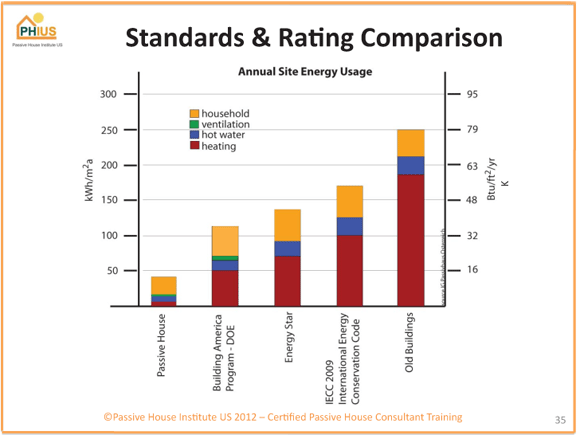
A bar chart titled 'Standards & Rating Comparison' compares the annual site energy usage of different building standards. The y-axis represents energy usage in kWh/m²·a on the left and Btu/ft²/yr on the right. The x-axis lists five building standards: Passive House, Building America Program – DOE, Energy Star, IECC 2009 International Energy Conservation Code, and Old Buildings. Each bar is divided into four color-coded sections: household (yellow), ventilation (green), hot water (blue), and heating (red). The chart shows that Passive House has the lowest energy usage, while Old Buildings have the highest, with heating being the most significant contributor to energy consumption across all categories. The source is Passive House Institute US (PHIUS) from 2012, as indicated at the bottom.
This video does an excellent job explaining the Passive House in 90 seconds…
References

  1. http://www.passivehouse.us/passiveHouse/PHIUSHome.html
  2. http://www.richardpedranti.com/passiveHouse.html
  3. http://vimeo.com/74294955#
Transduction Technologies
5005 Chicago St.
Omaha, NE 68132
402.213.3788

[email protected] 

We are an SBA Certified Small Business
NAICS codes: 541330, 541350, 238990, 519190, 541690, 541620, 541712
​
Copyright 2023 Transduction Technologies
  • Home
  • Commercial Services
    • 2018 IECC Test
    • Building Enclosure Testing
    • Data Monitoring
    • Energy Evaluations
    • Infrared Thermography
    • NFPA Enclosure Integrity testing
  • Residential Services
    • Passive House
    • New Homes
    • HERS Index
    • Energy Efficient Mortgages
    • Existing Homes
    • Building Owners/Managers
    • Tenants
  • Resource Center
    • 2018 IECC Testing
    • Houses of Worship
    • Schools & Community Centers
    • Shelters
  • Past Projects
  • Building Science
    • Articles
    • Midtown Monitor Columns >
      • Article 1: Seal Tight, Ventilate Right, Part 1 >
        • Supplemental Air Sealing Articles
      • Article 2: Seal Tight, Ventilate Right, Part 2 >
        • Residential Ventilation Calculation Examples
        • Ventilation Advise & Articles
      • Article 3: Should I service my air-conditioner?
      • Article 4: Home Performance Guild of Nebraska
  • Inflation Reduction Act
    • Residential IRA Benefits
    • Can I get a free heat pump
    • IRA Resoucres
  • About Us
    • Overview
    • Capabilities
    • Contact Us
    • Affiliations